

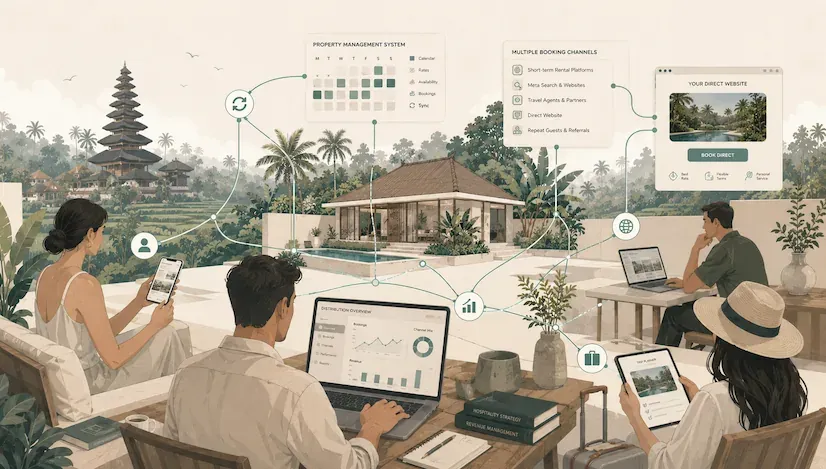
In Bali, many short-term rentals operate as independent villas. Property types vary, but the commercial challenge is similar: owners need to understand where bookings come from, how rates are managed, and when manual systems are no longer enough.
The property is prepared, photographs are taken, a nightly rate is selected, and the listing goes live. This can work while the operation is small and most reservations come from one place.
Complexity usually arrives gradually. The villa joins another platform. A guest asks to book through WhatsApp. Rates need to change for a busy period. Then someone must make sure that every calendar shows the correct availability.
At that stage, the owner is managing more than a property. They are managing distribution.
From my experience across hotels and independent villas, owners do not need to master every platform or hospitality system themselves. They should still understand where their bookings come from, what each channel contributes, and where manual management may create unnecessary risk.
Choose channels with a reason
Airbnb is one possible booking channel. Depending on the property, guests may also arrive through Booking.com, Agoda, Expedia, a travel agent, the villa’s website, or a direct inquiry.
Joining every available platform is rarely the best starting point. Each has its own commission, payment arrangements, promotions, cancellation terms, and customer base. Maintaining the listings also takes time.
The selection should reflect the property and its guests.
A villa that mainly hosts international holidaymakers may need a different mix from a property focused on domestic travelers or longer stays. A new property may rely heavily on OTAs while it builds reviews. An established villa with returning guests may have more room to develop direct bookings.
Supporting channels also influence the journey. Someone may discover the villa on Instagram, check its Google reviews, compare prices through an OTA, and contact the property through WhatsApp. All of those touchpoints contribute to one booking decision.
That is why social media shouldn't operate separately from distribution. The price, photographs, property details, and booking conditions need to remain consistent wherever the guest looks.
Pricing needs context
Independent owners often start by benchmarking nearby villas. This is useful, although location alone does not make two properties direct competitors.
The comparison also needs to consider bedroom count, facilities, property condition, review history, service level, and the experience offered to guests. Travel dates and booking conditions can change the value considerably.
A rate visible online may be part of a temporary promotion. It may apply to a non-refundable booking or exclude charges shown later. A new villa may intentionally price lower while collecting its first reviews.
Copying that rate can pull another property into a price competition without understanding the reason behind it.
Good pricing begins with knowing where the villa sits in the market. Rates can then respond to season, demand, booking pace, length of stay, and the property’s own performance.
Not every independent villa needs complex revenue software. Owners should at least know how their rates were decided and whether the comparison set still makes sense.
Direct booking grows through trust
Reducing OTA commission is often presented as the main reason to pursue direct booking. The guest sees the situation differently.
OTAs offer a familiar process. Reviews are visible, payment happens through a known platform, and cancellation terms are presented upfront. Booking directly with an unfamiliar villa can feel less secure, even when the rate is better.
A direct channel needs to create enough confidence for the guest to continue.
For some properties, this may involve a website with clear information and a secure booking engine. A smaller operation may begin with a simple website, an updated Google presence, reliable WhatsApp communication, and a consistent payment process.
Direct bookings often grow from people who already know the property. Returning guests, referrals, and social media followers have more reason to trust the business. Their relationship can continue without an OTA managing every future reservation.
This takes time. A direct channel should develop alongside OTA distribution, not be treated as an immediate replacement.
One villa using one platform may be manageable with a calendar and a clear manual process.
Once the same dates are sold through several channels, a missed update can lead to a double booking. A channel manager helps by connecting rates and availability across compatible platforms. When a reservation is confirmed, the connected calendars can update automatically.
Even a single villa may benefit from this if it actively sells through several OTAs and accepts direct reservations.
A property management system covers a wider part of the operation. Depending on the product, a PMS may organize reservations, guest records, payments, housekeeping, staff tasks, messages, and reports. Some include a channel manager and booking engine. Others require separate connections.
The number of units alone does not determine whether a PMS is necessary. Booking volume, active channels, staff coordination, reporting needs, and the amount of manual work matter too.
Buying software without understanding the process can add cost without improving control. The owner should first identify where information is being lost, repeated, or updated too slowly.
Independent villa owners do not need to perform every distribution task themselves. A manager, consultant, or specialist may handle much of the daily work. Owners still benefit from seeing the full picture.
They should know which channels produce bookings, how much those channels cost, whether rates remain competitive, and whether their current system can support growth.
Airbnb may remain an important part of the business. A direct website, channel manager, or PMS may become useful later. The right structure is the one the property can manage consistently without losing control of the guest experience.